Real Estate Marketing
How to Rank Above Zillow: Where Real Estate Agents Can Actually Win
You won’t beat Zillow for “homes for sale,” and you don’t need to. Here are the searches agents can win, what to build first, and what to stop paying for.
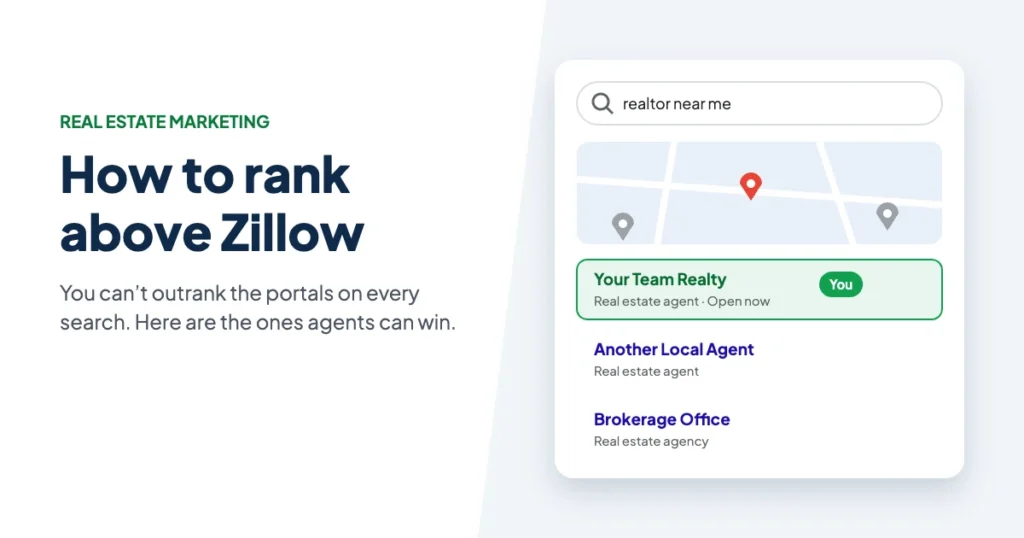
Short answer: You won’t rank above Zillow for broad searches like “homes for sale in Austin,” and you don’t need to. The way to rank above Zillow is to compete where portals are weak:
- Your own name and team name
- Neighborhood searches like “living in Travis Heights” or “Travis Heights realtor”
- Seller questions like “how much is my house worth in Round Rock”
- Google Maps, where agents can have their own profile and portals aren’t competing in the same way
Those searches bring fewer visitors than “homes for sale,” but far more of them are sellers looking for an agent.
Most agents try to beat Zillow, Realtor.com and Redfin at their own game: listing search. That’s a fight against companies with millions of pages and huge budgets. This guide shows where an agent can realistically win, what to build first, and what to stop wasting money on.
Why Zillow wins the “homes for sale” searches
Portals win broad listing searches because they have what those searchers want: every listing, photos, filters and price history, on one huge, heavily linked site. Someone typing “homes for sale in Austin” is browsing, and a portal is the best answer for browsing.
Your IDX feed shows the same listings as hundreds of other agent sites, so it rarely gives Google a reason to rank you above the portal. That’s not a failure of your website. It’s the wrong battle.
Where agents can rank above Zillow
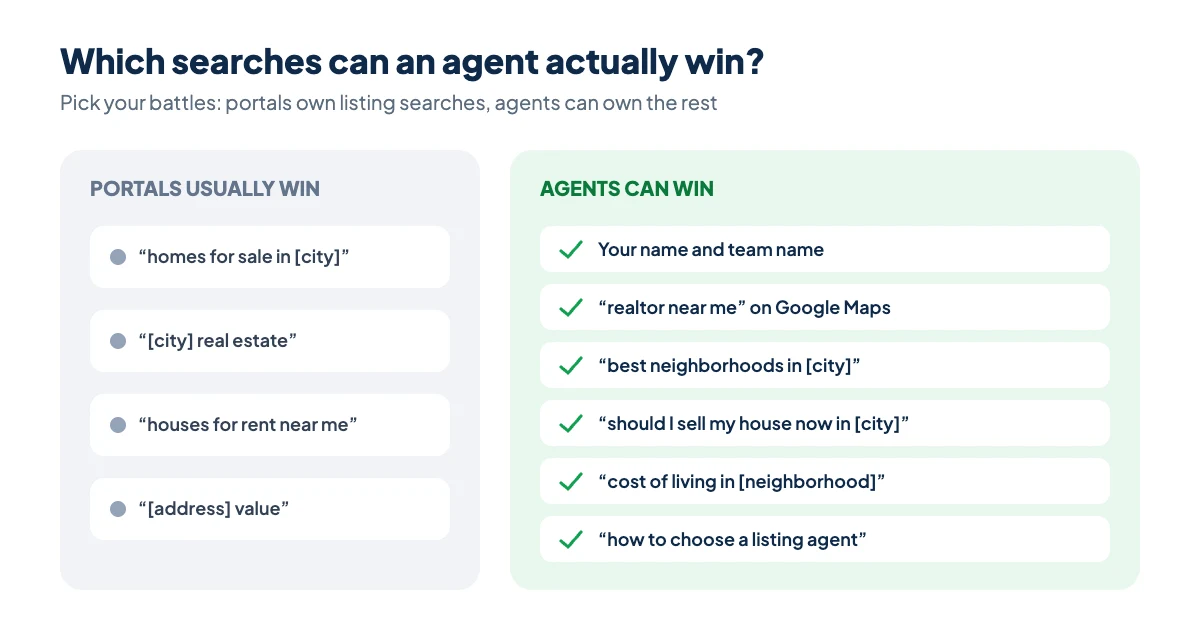
Agents win on searches that need a person, a place, or local judgment. Portals are built for listings, not for those questions.
| Search type | Example | Who usually wins today | Can an agent win? |
|---|---|---|---|
| Broad listing search | homes for sale in Austin | Portals | Rarely, don’t focus here |
| Your name | Jane Smith realtor | Whoever has the most complete presence | Yes, this should be yours |
| Agent near me | real estate agent near me | Google Maps profiles | Yes, with a strong profile and reviews |
| Neighborhood living | living in Travis Heights | Mixed, often thin pages | Yes, with genuinely useful area pages |
| Seller questions | is now a good time to sell in Round Rock | Mixed | Yes, with clear local answers |
1. Own every search for your name
When a past client recommends you, the next person Googles your name before they call. That first page should be entirely yours and tell the same story everywhere:
- Your website’s about page, with your photo, areas, credentials and reviews
- Your Google Business Profile
- Your Zillow, Realtor.com and brokerage profiles, with the same name, photo and contact details
- LinkedIn and the social profiles you actually use
Consistency matters more than volume. If one profile has an old phone number or a different headshot, fix it before you build anything new.
2. Get your own Google Business Profile right
Google’s guidelines specifically cover individual practitioners such as real estate agents, so you can have a profile of your own as well as your brokerage’s. That profile is what shows up for “real estate agent near me” on Google Maps.
- Use your real name as it appears professionally, without keywords stuffed in
- Choose the right category and list your services
- If clients don’t meet you at your address, hide it and set the areas you serve
- Add real photos and post updates about listings and the market
- Ask every client for a review after closing, and reply to each one
Follow your brokerage’s rules on naming and branding too. Some brokerages have specific requirements for agent profiles.
3. Build neighborhood pages people actually want to read
Most “neighborhood pages” are a paragraph of filler above a listing feed. That’s why they don’t rank. A page that genuinely helps someone deciding whether to live somewhere is a page portals don’t have.
What a strong neighborhood page includes:
- What it’s really like to live there, in your words, from local experience
- Streets, pockets and housing types, and who each tends to suit
- Schools, commute times, parks and the places locals actually go
- Recent market activity in plain language, within your MLS rules
- Your own photos, not stock images
- A clear next step: a valuation request or a short call
Start with the two or three areas you most want listings from. One excellent page beats ten thin ones.
4. Answer the questions sellers ask before they choose an agent
Sellers research for months before they list. They search questions like:
- How much is my house worth in [town]?
- Is now a good time to sell in [town]?
- What does it cost to sell a house in [state]?
- Should I fix up my house before selling?
Answer each one clearly and locally, and connect it to a home valuation page. These are the visitors most likely to become listings, and they’re searching for exactly the expertise you have.
5. Stop paying for things that won’t move you past Zillow
- Chasing “homes for sale in [city]” with blog posts or link building
- Generic market-update articles copied across hundreds of agent sites
- A brokerage template site you can’t edit, where your pages aren’t really yours
- Reports full of traffic graphs instead of valuation requests and calls
Put that budget into your profile, reviews, a handful of excellent area pages and seller content.
How AI search changes this
More buyers and sellers now ask ChatGPT or Google’s AI for an agent recommendation. Those tools lean on the same signals: consistent profiles, reviews and clear pages that explain who you are and where you work. The steps above help you appear there too.
Frequently asked questions
Can a real estate agent outrank Zillow?
Yes, for the right searches. Agents rarely beat portals for broad listing searches, but they can outrank them for their own name, “agent near me” on Google Maps, neighborhood living searches and local seller questions.
Does IDX help my site rank?
IDX is useful for visitors who want to browse, but the listing data is the same across many sites, so it rarely helps you outrank portals on its own. Your original area pages and seller content do the ranking work.
Can I have my own Google Business Profile if I work under a brokerage?
Generally yes. Google’s guidelines cover individual practitioners such as real estate agents. Check your brokerage’s naming and branding rules before you set it up.
How many neighborhood pages should I create?
Start with two or three areas where you most want listings, and make each one genuinely useful. Add more once those are ranking and bringing inquiries.
How long does it take to rank for neighborhood searches?
Your name can improve quickly once profiles are consistent. Neighborhood and seller searches usually take a few months as pages, reviews and links build up.
Want help building this for your market? See how we approach local SEO for real estate agents, how we build agent websites that win seller leads, or start with our real estate marketing overview.
Sources
This article is general information. Follow your brokerage, MLS and state advertising rules.