Med Spa Marketing
Can You Advertise Botox on Google? The 2026 Rules for Med Spas
Yes, you can, but three rules decide whether your campaign runs or gets limited. Here’s what US med spas can do today, what needs certification, and how to build ads that stay approved.
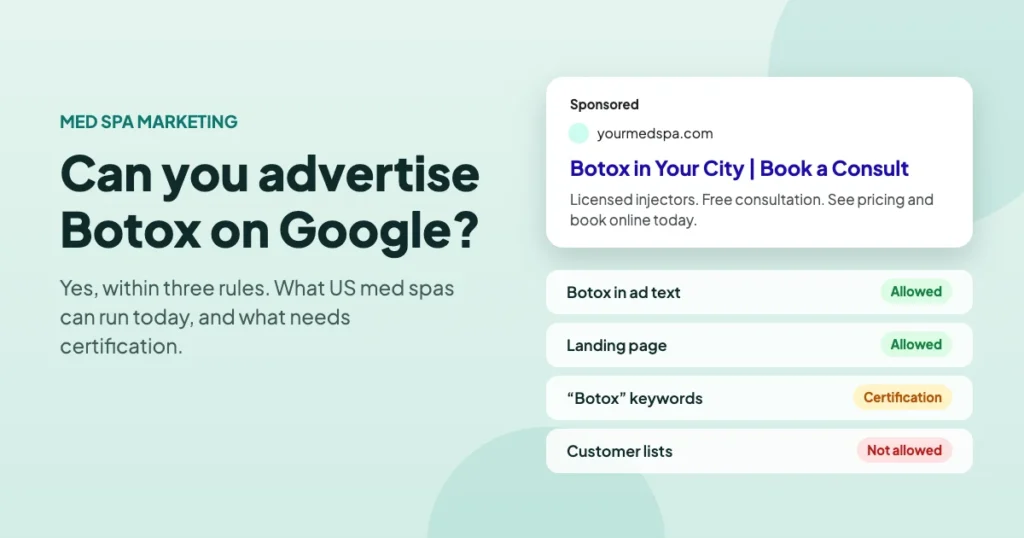
Short answer: Yes, you can advertise Botox on Google if your ads target the United States. Google lets you use “Botox” in your ad text and on your landing page without any certification. Two things are still off-limits unless you’re set up for them:
- Bidding on “Botox” as a keyword needs Google certification.
- Remarketing and customer-list audiences can’t be used on ads that mention prescription drugs.
Everything else, like treatment keywords, booking pages and call ads, works normally.
If your Botox ads have been disapproved, limited or have quietly stopped spending, it’s usually one of those two rules, not your offer. Here’s what the rules say, why Botox is treated differently from a HydraFacial, and the campaign setup that keeps med spa ads running. It’s written for US clinics. Rules outside the US are stricter.
What Google allows for Botox ads in the US
Google treats Botox as a restricted drug term. For US campaigns, that limits how you use the name, not whether you can mention it.
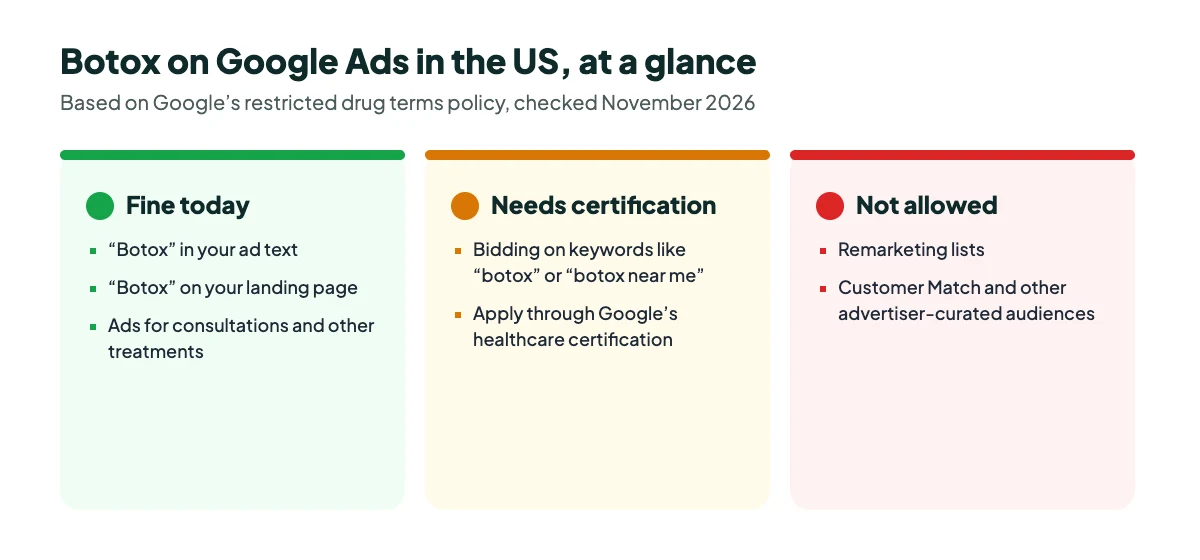
| Where “Botox” appears | Allowed for US campaigns? | What you need |
|---|---|---|
| Ad headline or description | Yes | No certification. Follow local laws. |
| Your landing page | Yes | No certification. |
| A keyword you bid on, like “botox near me” | Only if certified | Google certification for restricted drug terms. |
| Remarketing or customer-list audiences | No, on ads that use drug names | Use Google’s predefined audiences instead. |
| Ads targeting outside the US, Canada or New Zealand | No promotional use | Different rules apply. |
Google’s policy page says it directly: you can use these terms in ads and landing pages, but you must be certified in order to keyword-target these terms
.
Why Botox is treated differently from your other treatments
Botox is a prescription drug. Botox, Dysport and Xeomin are prescription neurotoxins, so their names fall under Google’s Restricted drug terms policy. A HydraFacial, microneedling or laser hair removal is a service, so those keywords run like any other.
Dermal fillers are a separate case. In the US, fillers are regulated as medical devices rather than drugs, so filler brand names generally aren’t prescription-drug terms. Check any brand against Google’s list before you rely on it, but don’t treat fillers and neurotoxins as the same problem.
Prescription-drug content is also a sensitive interest category in Google’s personalized advertising rules. That’s why your own remarketing lists stop working on ads that mention a drug name.
Other health practices run into the same sensitive-category limits. Ads about invasive procedures, such as dental implants, and about chronic conditions can’t use remarketing either. We plan around this in Google Ads for dentists and Google Ads for chiropractors.
What changed in late 2025
Google rewrote the prescription-drug rules in October 2025 and split them by country. Campaigns targeting Canada, New Zealand and the United States can use drug names promotionally, within local law. Campaigns targeting anywhere else can’t.
Enforcement started on October 29, 2025. Google also says it will warn an advertiser at least seven days before suspending an account under this policy, so a policy email is your cue to fix things, not to panic.
Reading older advice? Many guides written before late 2025 say you can’t mention Botox in Google Ads at all. For US campaigns, that’s out of date.
How to advertise Botox on Google without getting disapproved
Keep the campaigns that use drug names separate from the ones that don’t, and give each treatment its own landing page. Here’s the setup.
1. Split your campaigns in two
- Neurotoxin campaign: ads can say “Botox.” Keywords use non-drug terms. No remarketing or customer-list audiences.
- Everything else: fillers, facials, laser and your brand name. Keep drug names out of these ads and pages, and you can use remarketing here.
Splitting them also makes problems easy to spot. If one campaign gets limited, you know exactly why.
2. Build keywords around the problem, not the brand
Without certification you can’t bid on “botox,” so use the words people search for the problem and the treatment type:
- wrinkle relaxer near me
- forehead lines treatment
- crow’s feet treatment
- frown lines (11 lines) treatment
- anti-wrinkle injections
Add your city or neighborhood to the ones that matter most, and check the search terms report every week for anything you don’t want to pay for.
3. Give each treatment its own landing page
Someone searching for forehead lines should land on a page about forehead lines, not your homepage. A strong treatment page answers what people won’t ask on the phone:
- Who it’s for, and who it isn’t for
- A price range or starting price
- How long results usually last, as your medical director describes it
- Downtime and what to expect on the day
- Who does the injecting, with credentials
- A booking button, a call button, and a short callback form
When we built a treatment page for an aesthetic surgery clinic, we put all three contact options at the top: call, book, or request a callback. Visitors arrive at different levels of readiness, and one button doesn’t suit all of them. If your current pages can’t do this, that’s where a treatment-focused med spa website starts paying for itself.
4. Write ad copy that doesn’t over-promise
Health and cosmetic ads get extra review. Skip guarantees, “painless,” and before-and-after promises in the ad text. Lead with what actually wins bookings: who injects, how the consultation works, natural-looking results, and how to book. Use the drug name accurately, and only for the product you actually use.
State rules matter too. Who can inject, who must supervise, and how treatments can be advertised vary by state, so have your medical director sign off on ad copy.
5. Track consultations, not clicks
Set up booked consultations and phone calls as conversions. A campaign with cheap clicks and no bookings is the expensive one.
Can’t bid on “Botox near me”? Rank for it instead
The restricted-terms rules apply to ads, not to Google Maps or regular search results. Your clinic can show up for “Botox near me” organically without any ad certification.
That takes three things: a dedicated Botox page on your site, Botox listed as a service on your Google Business Profile, and recent reviews that mention the treatment naturally. It’s slower than ads but costs nothing per click, and it covers the exact searches your ads can’t. This is a big part of what local SEO for med spas should focus on.
Mistakes that get med spa ads limited or disapproved
- Adding “botox” keywords without certification. The ad text is fine. The keyword isn’t.
- Attaching remarketing or customer lists to a campaign whose ads mention a drug name.
- Naming a brand you don’t use, such as saying Botox when you inject Dysport.
- Copying a campaign to other countries. Outside the US, Canada and New Zealand, promotional use of drug names isn’t allowed.
- Ignoring policy emails. You get a warning first. Use it.
What about Facebook and Instagram ads?
Meta has its own rules for health, wellness and appearance ads, and they’re separate from Google’s. Check Meta’s current advertising standards before running before-and-after images or appearance claims. Many clinics use Meta for promotions and awareness, and Google for people already searching for a treatment.
A quick pre-launch checklist
- Campaign targets the US only
- No drug names in your keyword list, unless you’re certified
- No remarketing or customer-list audiences on drug-name campaigns
- One landing page per treatment, with price, downtime, injector and booking
- Ad copy approved by your medical director
- Bookings and calls tracked as conversions
Frequently asked questions
Do med spas need certification to run Botox ads on Google?
Not for ad text or landing pages in US campaigns. Google allows the name “Botox” there without certification. You do need Google certification to bid on “Botox” or other drug names as keywords. Google decides which businesses qualify, so check in your Google Ads account before planning around it.
Can I bid on “Botox near me”?
Only if you’re certified for restricted drug terms. Without certification, bid on treatment and problem keywords like “wrinkle relaxer near me,” and work on ranking for “Botox near me” organically through your website and Google Business Profile.
Why did my remarketing stop working on my Botox ads?
Prescription-drug content is a sensitive category in Google’s personalized advertising rules, so your own audience lists can’t be used on ads that mention drug names. Use Google’s predefined audiences on those campaigns, or run remarketing from a separate campaign that doesn’t mention drug names.
Are filler brand names restricted like Botox?
Generally no. In the US, dermal fillers are regulated as medical devices, not prescription drugs, so they usually aren’t restricted drug terms. Check any brand name against Google’s list before launching.
Can Google suspend my account over a Botox ad?
Repeated violations can lead to suspension, but under the late-2025 policy update Google says it gives at least seven days’ warning first. Fix the flagged ads or keywords as soon as the warning arrives.
Do these rules apply outside the US?
No. Campaigns targeting countries other than the US, Canada and New Zealand can’t use prescription-drug names for promotion at all.
Running a med spa and want this handled properly? See how we set up Google Ads for med spas, or start with our med spa marketing overview.
Sources
- Google Ads Help: Restricted drug terms
- Google Ads Help: Update to Healthcare and Medicines Policy (October 2025)
- Google Ads Help: Restricted drug terms in personalized advertising
Policies change. We checked these pages in November 2026. This article is general information, not legal or compliance advice.